Pages

Showing posts with label pregnancy. Show all posts

Thursday, December 12, 2013

The real test to know whether you're in labor

So you know those lists that help you identify whether you're in true labor or not? Turns out, the only real way to know is whether you walk out of the hospital with a baby inside your belly or outside*.

This is what he looks like and we'll call him Little Brother on the internet.


*coming from yours truly, who had to go to the hospital THREE times before actually having a baby. Turns out, you can go to 4 cm dilated with hours of very regular contractions and baby all descended and what not and then go home and wait another 6 (SIX!) days before having said baby.

Monday, November 25, 2013

Eating dates to speed up your due date?


When you’re very pregnant, even if you’re a rational scientist-type person, you can sometimes not help but googleing “ways to induce labor”. My google even already autofilled it for me, it must know more than me about myself. And instead of reading scientifically sound pieces about what might determine when the baby comes, I find myself reading about acupuncture, castor oil and all that. But wait a minute, what does it say on the bottom of the page? Something about a recent scientific study showing that eating dates has a favorable effect on labor and delivery? I had to check that out.

The paper is from a group of scientists from Jordan, published in a journal with the astonishing impact factor of 0.55, and looks at two groups of 45 and 69 women. One group of women eats at least 6 pieces of date fruit in the four weeks prior to giving birth, whereas the other group eats none. It’s a prospective study, meaning that the women who eat dates are not assigned to that group, which I think is important to notice. The researchers find that in the date-eating group, the women arrived to the hospital more dilated than the non-date-eating group, had their membranes intact more often, had more spontaneous labor, and the use of Pitocin was lower. Also, the duration of the first stage of labor was shorter, but I wonder if that isn’t just the case because they arrived at the hospital more dilated. I don’t know about Jordan, but I could imagine that the group of women who eat 6 dates each day, is a different group of women to begin with. They might be the women who refuse induction with Pitocin, stay home longer before going to the hospital, refuse to have their membranes artificially ruptured, etc etc. We might just be looking at two different groups of women who happen to be different in their date fruit consumption. The researchers conclude: “that the consumption of date fruit in the last 4 weeks before labour significantly reduced the need for induction and augmentation of labour, and produced a more favourable, but non-significant, delivery outcome. The results warrant a randomised controlled trial.” I totally agree with that final sentence.

And for those of you wondering, I have not been eating any date fruits over the last couple of weeks.

Monday, October 14, 2013

We made a co-sleeper!

Normally, I save all my craftiness for in the lab. When not in the lab, I don't really enjoy making crafty things, and if I ever attempt, I'm horrible at finishing projects. This is illustrated by the fact that I have several unfinished craft projects in my old room in my parents' house. Nowadays, I just don't really try it anymore. But last Friday Dr. BrownEyes and I did a very crafty thing: we made a co-sleeper from our IKEA Somnat crib and our IKEA Malm bed. Ours is not as fancy as this example from a slightly different crib, but I'm still very proud of the result.
We used this equation:
The Malm bed.
 +
The crib that BlueEyes used for maybe 2 months, after which we realized we kept walking back and forth and he kept ending up in our bed anyway.
 =
A huge bed, so prospective baby can co-sleep safely.
In short, we removed the side of the crib (which is a feature this crib already has), we elevated the crib with wooden blocks and since the Malm bed has a wooden edge next to the mattress, when elevated just enough, the crib mattress can lay on that wooden edge and align nicely with the big mattress. We pushed the crib against the wall and the bed against the crib and will fill the hole on the left in the crib with rolled-up towels, so the two mattresses are snug against each other.

Friday, September 13, 2013

If I stand for too long I faint


Both pregnancies I’ve had this annoying thing that if I stand for longer than 30-40 minutes, I get lightheaded and am on my way to fainting. I don’t know why this happens, because my blood pressure does not drop very low; last time when my midwife measured it, it was a very average 120/70. Usually this is not a big deal, because if I sit down for a little bit it goes away. But sometimes there’s nowhere to sit, for example when waiting in line at a very busy restaurant that just opened. This happened a couple months ago and I was put on a chair by a colleague just before falling to the floor. Or when waiting in line at the airport, but then I can usually move my legs enough to prevent actually fainting. 

Another occasion where you have to stand for this amount of time is when giving a talk about science. That happened yesterday. My talk went very well I think, but a couple minutes into the questions I felt kind of lightheaded. I was hoping it would go away but I felt myself get more and more dizzy and was hoping people couldn’t see anything… At some point, when I realized I wasn’t done answering questions anytime soon and I just had to sit down. So I did, mumbled some apology for it and luckily the two fellow post-doc moms that I knew in the audience looked very understanding. I felt embarrassed, but I guess fainting in front of an entire audience would have been worse. I finished answering questions and the PI that invited me said he was impressed that I came to deliver my talk at 7 months pregnant, so I guess it wasn’t a big deal. But I did leave the talk feeling a bit embarrassed about the situation.

Thursday, August 29, 2013

This is your brain on pregnancy


Last pregnancy, I did mostly experimental work and very little writing. That was nice, as my auto-pilot worked very well, but my thinking and focus abilities seemed a bit disturbed by being pregnant. This time around, I still need to finish 4 grants before this baby is due by the end of November. Truth be told, one is a resubmission and the other three have been in the making for a couple months, so I still think this is very doable. However, I do feel that some days my ability to stay focused and remember where I read something, or which paper to refer to seems a bit off. Is this really a pregnancy thing? Is something happening to my brain?! The all-knowing Dr. Oz says the following about it

 “Dr. Oz says a woman's brain also shrinks by about 8 percent. "You don't lose cells. The cells get smaller," he says. "It might be because you're focused on one thing, but the good news is after you give birth, your brain begins to rewire quickly. … Your brain actually gets more powerful than before you got pregnant."

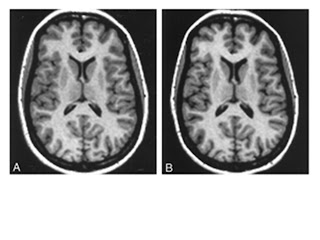
Apparently he knows more than the rest of us, because the only data I could find were structural MRI studies showing that indeed the brain shrinks a bit, and the ventricles containing cerebrospinal fluid get a bit bigger when you are pregnant. The 8% (that you read on a lot of popular pregnancy websites by the way) seems to be a bit much too, as this study for example just finds a change of approximately 4% in brain size (in healthy pregnant women that is, women with preeclampsia have more brain shrinkage). And with MRI there is really no way that one can say that this is your cells shrinking and especially not that after birth your brain rewires quickly: you can simply not see that on an MRI.

Yes, this is your brain on pregnancy, from this study. A is the pre-pregnant brain, and B is the pregnant brain, at full term. Note that the ventricles are enlarged in B. (Are you also that annoyed by popular science magazines saying “this is your brain on… [insert whatever] and then show a picture of an MRI? Me too!)

So yes, your brain gets a bit smaller when you are pregnant. But does a 4% decrease in size affect your ability to write grants? Only time will tell.

Tuesday, July 2, 2013

The home of the free toilets


Whenever we go back to the homecountry, I’m excited about all the things I can eat there that are hard to find here in the US. However, some things are not that great in the homecountry, for example the availability of bathrooms. And for someone who is pregnant and needs to pee at least once every half hour, this is quite an issue. What I love about the US is that everywhere you go, there’s a bathroom that you can use for free. This might sound weird if you live here, but for example in the homecountry there are no toilets in parks (not even porter potties), there are no bathrooms in supermarkets, and some trains don’t even have toilets in them. Also, whenever there are bathrooms, like in the train station, in a department store or in a gas station, you usually have to pay for them. It usually costs 50 eurocents (~$0.60) to use the bathroom. So for the remaining time we will live here, I will certainly appreciate that this country is the home of the free toilets.

Thursday, June 27, 2013

Like a deer in the headlights


I often think about what kind of qualities a scientist should have. I think a scientist should be curious, adventurous (science-wise, not necessarily bungee-jump-wise) and inventive. But lately, it also seems like an important part is to be resilient to stress about having an insecure job. As I said before, whether or not I will have the position I want in the homecountry depends on whether I get a grant (any grant) before next year when we are moving back. This type of insecurity, that I know almost every scientist faces, does not make me work better. To be honest, it stresses me to the point that when I have to write a grant, I can’t because I keep thinking: ‘this has to be awesome, or else’. I think some people excel under pressure, but I’m currently not one of those.

You have to understand that I was raised in a country that has a lot of social security. Everybody has healthcare - and with that I mean real healthcare, not the one where you have to co-pay 20%, leaving you bankrupt after an expensive procedure – and it’s a lot harder for employers to fire people with a contract than in the US. Deep down, I did not envision being older than 30, not knowing where I would work next year or whether I would be able to afford a house.

You also have to understand that wanting to get a grant funded to secure a position seems to be my type of nesting. Being pregnant has amplified these feelings enormously, because I seem to want to imagine what life will look like when this prospective baby is born, and moving countries when he or she is only 5 or 6 months does not really help in this process.

It would help if Dr. BrownEyes would have be a millionaire, or at least have a job that we would know he could keep and that would bring in money, but he doesn’t, because he’s also a scientist. This is great, and his enthusiasm for science is one of the things I like about him, but it doesn’t help in my anxiety about getting a job.

So does this make me a bad scientist? It did for a while, because I really felt like a deer in the headlights trying to write grants and papers, but now that I know that I can at least get bread on the table doing another post-doc that gives me some room to breathe, and to be good and creative while writing grants again. But why aren’t there more scientist-jobs for people who don’t love insecurity about grants and their future (and the future of those in their labs)??