I was tied to my electrophysiology rig for the past three days and completely missed the #postdocalypse hashtag on twitter. It started with Ethan Perlstein's post where he describes how even a "prestigeous independent postdoctoral fellowship at Princeton" did not guarantee him a TT position at a top institute. At almost the same time as I read about this on ProflikeSubstance's blog some people on twitter were talking about how the median age to first receive an R01 is 41. And I thought: sure all of this sucks, and we need to do whatever we can to try and change this; it would be great if there was more money for science, and a higher chance of getting a desired TT job. But at the same time, all this panic is not getting us anywhere.
Sometimes PIs lose funding, or decide to move to the other side of the US, or decide to fire a bunch of postdocs, and not too long ago one of those scenarios was a serious option in our lab. I thought for a while that I could lose my job, and I seriously thought about what I would do in that case. I could make myself useful in another lab, I could stay home with BlueEyes. I could become a yoga teacher or a babywearing instructor or both. I could write a book. All of a sudden the possibilities were endless, and I was almost sad that this scenario wasn't going to happen and I continue to be a scientist.
What I'm trying to say is that even though you've worked to become something ever since high school, and you will be extremely disappointed when you don't become what you want because of factors out of your control, that is not all there is. Seriously, it's not. And sometimes it is extremely liberating to realize that.
In case you worry what all this hippie talk is doing here: don't worry, next time I will write a disgruntled postdoc post again.
Thursday, February 7, 2013

Tuesday, January 29, 2013
All the reasons NOT to go to grad school
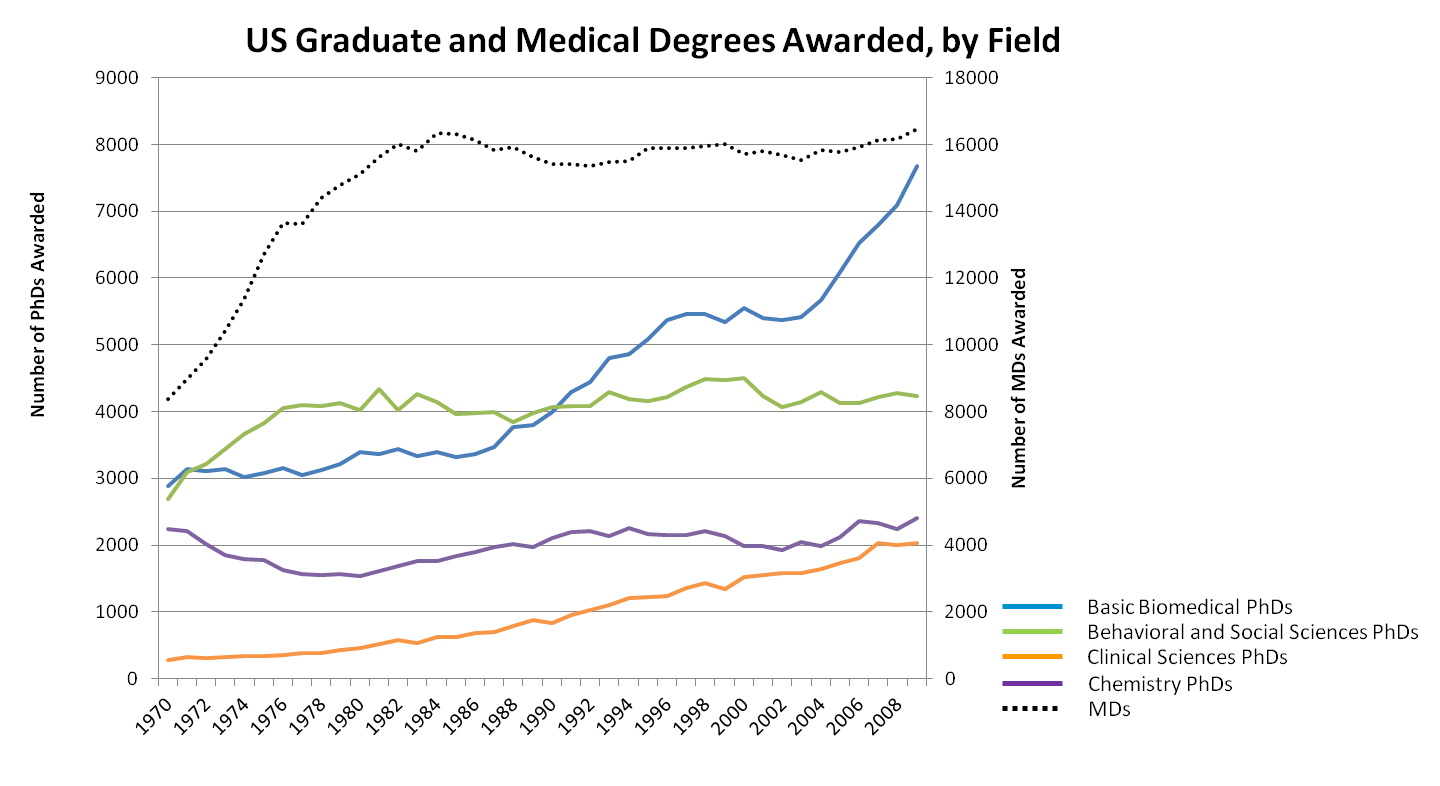
DrugMonkey is trying to fix the NIH
and especially the way the money is allocated with lots of ideas, one of them
being to stop training so many PhDs.
 |
| Source |
If you see this graph, it makes sense
a lot of sense, because indeed biomedical PhDs are going through the roof it
seems. But who are all those people that go to grad school and why do they do
it? As my summer student said after hearing us complain all summer about how
little we got paid and how hard it was to find jobs after a PhD/post-doc:”I’m
not so sure I want to go to grad school anymore”. Because you can blame it on
the NIH if you can’t find a job or get a grant, but you can also perhaps blame
it on yourself. So here are a couple reasons why you should NOT go to grad
school:
1. Not knowing what else to do. There
are people who are done with undergrad, may have a year of technician
experience and then don’t really know what to do with their lives. Grad school
seems like an answer, because it will occupy you for at least another
5-infinite years. Don’t do it though. Because when you’re done with grad
school, you will be older, more jealous of your friends who do earn actual
money and still clueless about what to do next. Also, you will be overqualified
for a lot of things.
2. There are no other jobs available
because of the economy. This is kind of related to reason 1, and of course it
is nice to know that you will be paid (albeit little) for the next 5-infinite
years, but if your only reason to go to grad school is to keep you from being
unemployed, don’t do it. Search longer for something you actually want, because
being stuck in a lab when you don’t really want to be there is not going to
make you happy, and again, you might be overqualified for other things when you’re
done.
3. You want to do something sciency. This
might be a good reason to go to grad school, but think about it first. Because
if you want to be a science writer for example, you don’t need a PhD.
And there are many other jobs, for example in industry where you don’t need a
PhD to do sciency things.
What other bad reasons can you think
of for going to grad school?
Monday, January 28, 2013
Practicing patience
I think it’s safe to say that I’m an impatient person. I’m that
kind of annoying person that will email you if I haven’t heard back a week
after I sent you a manuscript. I like to do things fast and efficient. I think
this makes me a good (albeit annoying) scientist, but it makes a pretty crappy
parent.
BlueEyes has gotten to that age when if he doesn’t like something
he will throw himself on the floor crying. So this weekend, I spent 10 minutes
that felt like an hour sitting on the sidewalk waiting for him to calm down
after I told him that we were not going to cross the very busy street during
our walk. Before that, I told him I was going to put his shoes on, but he
didn’t want to wear those shoes, he wanted to wear his Crocs. This would have
been fine, had there not been a good inch of snow outside. So it was kind of a
struggle, and I haven’t even mentioned yet that all of this was done on a
minimal amount of sleep, because for some unknown reason BlueEyes has been
waking up even more frequently than normal for the past week.
So I try to stay calm and patient and kind and understanding and
loving, even though I thought I was none of those things. Apparently I am and
apparently this is what having a child does to you. It shows you that you have
what it takes to raise this little person. On a good day, that is.
Wednesday, January 23, 2013
Dealing with HR, a rant
<rant> Apparently, to become a post-doc 2.0 A LOT of HR
stuff needs to happen. I need to get background-checked and they need to see
proof of my education. And that’s where it becomes annoying. Because my
graduate university, like many other European universities, issues PhD diplomas
in Latin. Yup indeed: Latin, the language of science. And since we don’t do any
classes for our PhD I don’t have a list of grades. Which means I can’t give you
a list of grades, BECAUSE THERE IS NONE. And no, I can’t have an official
transcript of my diploma here tomorrow, because it has to come from Europe, and
Europe is already closed at this hour. So no, I don’t know when it is going to
be here yet, because I can’t call and ask, because Europe is closed for today.
Am I really the first non-US person to go through this process here? I find it
hard to believe that. </rant>
Tuesday, January 22, 2013
A post-doc by any other name...
Sometimes I see people on LinkedIn change their profession from
Post-doc to Research Associate. That always makes me laugh a little and until
recently led me to think that those people had been a post-doc for too long,
and therefore just gave it a different name. But that is not true, as I have
recently discovered that Research Associate is actually a thing. Because yours
truly is becoming one, which not only allows me to change my profession on
LinkedIn, but also allows me to receive a substantial increase in pay (which
then causes me to lose the daycare fellowship that we have, so not much of a
net increase, but still).
The reason I am becoming a Research Associate is because only then
can I be a co-investigator (is that the correct term?) on my PIs next R01
renewal, for which I have a lot of ideas and preliminary data. I have also been
involved in setting up a successful collaboration that has led to these
preliminary data. The deal will be that if we get the grant and I leave, I will
be able to take my chunk of this money (which is nice, because since I’m not a
citizen I am not allowed to apply for a lot of US funding).
So this is all really nice, but of course in the end I’m still a
post-doc; doing experiments, panicking about writing papers and trying to find
free cookies (that’s a pretty accurate job description, right?).
Thursday, January 17, 2013
Writing your own letters of recommendation
The unimaginable has happened: there is an add for a TT job* in the
home country. So obviously I (and probably another 16 million people) am
applying. So I have to write a research statement and a teaching statement
(AARRGH I thought I didn’t need teaching experience if I was going to be a
career post-doc). And on top of that I need 3 letters of recommendation. The
first one is going to be from my current PI, which will be easy, I just ask
him. The second is going to be from my grad school professor, which is going to
be a bit harder, because he makes me
write my own letters of recommendation (yes this sucks). The third one is
going to be a bit harder. I have a collaborator in the home country who has
written letters for fellowships and such, but I’m already writing grants with
this person and even though ze says I should totally apply for this job, ze
also told me ze would prefer if I would work with hir. So it feels weird to ask
this person for a letter. I don’t want to ask any of the people in my committee
because they will also let me write my own letter and it’s even harder (and
somewhat schizophrenic) to write two different letters on behalf of different
people for yourself. My PI told me to ask someone in the field who I haven’t
worked with but knows my work. I have such a person who I met at a meeting and
who has written a letter for me in the past, so I think I’ll ask hir again.
But first, on to the hardest part: writing that letter for myself
on behalf of my grad professor…
*So I can finally make use of all the super useful advice on Dr. Becca's TT job aggregator
Subscribe to:
Posts (Atom)